2014-10-25 Carmen (G. Bizet), Teatro de la Zarzuela (Madrid)
Carmen = María José Montiel
Don José = Javier Palacios*
Escamillo = Rubén Amoretti
Micaëla = Sabina Puértolas
Zuniga = Francisco Tójar
Moralès = David Rubiera
El Donairo = Javier Galán
El Remendado = Néstor Losán
Frasquita = Isabel Rodríguez García
Mercédès = Marifé Nogales
CURRO FLORES = José Vicente Ramos
UN GUÍA = Juan Pedro Schwartz
Yi-Chen Lin, conductor
Orquesta de la Comunidad de Madrid
Coro del Teatro de La Zarzuela
Director:
Antonio Fauró
Stage directo - Ana Zamora
Sets - Richard Cenier
Costumes - Deborah Macías
Lights - Pedro Yagüe, Miguel Ángel Camacho
Asesor de verso - Vicente Fuentes
Asesor de movimiento coreográfico -
Javier García Ávila
Video design - Álvaro Luna
Director assistant - Fuensanta Morales
Costumes assistant - Anuschka Braun
Sets assistant - Almudena Bautista
Maestro repetidor - Andrés Junco
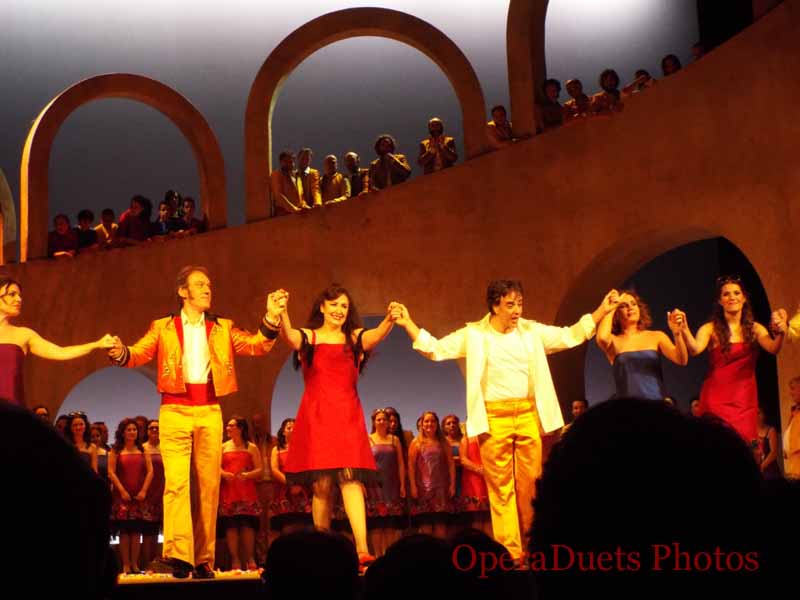
Yes that was the announcement that started this Carmen in Madrid's Teatro de la Zarzuela. And a great Don Jose he was, this Javier Palacios on Saturday, October 25th, 2014. Maria Jose Montiel was Carmen just as expected.
This was not the usual Carmen, this was an opera turned zarzuela but for me it was nothing like a true zarzuela just Carmen sung and spoken in Spanish. No Lillas Pastia here, in this Carmen he was names Curro Flores. Here the spoken dialogue was in Spanish almost the same as the original French but expanded to more dialogue and more realistic in then Spanish version. But in this version I could here no doubt the music was French. Strange that when sung in French I could feel it spanishness and only lose Spain and suddenly be in France in the dialogue.
Zarzuela it might not be but the cast was strong with Maria Jose Montiel as a great Carmen, Javier Palacios also in great voice and believable as Don Jose. Sabina Puértolas as Micaela was a wonder as a strong Spanich Micaela. Rubén Amoretti was a rather usual Escamillo when compared to Montiel, Palacias and Puertolas. Francisco Tójar as Zuniga and David Rubiera as Morales were both great actors and singers.
Ana Zamora as stage director created a bright colored Carmen but her idea was that Carmen was to be very feminine but not feministic. That sound like someone who thinks that feminists can not be feminine. She tried to make Carmen into something "more" by setting each act into a newer time so Carmen ended in the 1960s or so. But Carmen can very well be a femistic idol, she rules her own and no man can make her different. Don Jose is a man still very much in the paternalistic pattern, his idea of honor, and he thinks Carmen can be become his help mate. He never listens to her views or believe in them as real. In the end he can only look at Carmen as an Idol or a Demon. Don Jose never sees himself as a man who chooses, so he think he has to kill her when she refuses to save him from himself. Micaela is a brave woman even if she fears Carmen. She never gives up. The soldiers street harassment of Micaela as young, unprotected girl (17) walks into Sevilla to ask after Don Jose, the officer. Escamillo, the cynic, is he really that much better than the other men, or is he is just the benevolent sexist. And what would really be Carmen's story if Jose did not kill her? Maybe we should also ask how happy would Micaela and Don Jose be together if Carmen never happened to them. What would be Micaela's story?
Bright colored Carmen, sweetly done, but still no layers here in Ana Zamora's zarzuela version of Carmen. Still: Viva Espana!!!
CARMEN
Zarzuela en cuatro actos, basada en la ópera cómica de Ludovic Halévy y Henri Meilhac
Traducción de Eduardo de Bray
Música de GEORGES BIZET
Estrenada en el Teatro-Circo Alegría de Barcelona, el 7 de abril de 1890
Nueva producción del Teatro de la Zarzuela
FECHAS Y HORARIOS
10, 12, 15, 17, 19, 22, 23, 25, 26, 29, 30 y 31 de octubre de 2014
19:00 horas (domingos, a las 18:00 horas)
For more reviews from my travels, see www.operaduetstravel.com If you want to see more photos from my OperaDuets Travels, go to www.operaduetsphotos.com



 Posts

