Pages

Showing posts with label Julia Gertseva. Show all posts

Monday, October 30, 2017

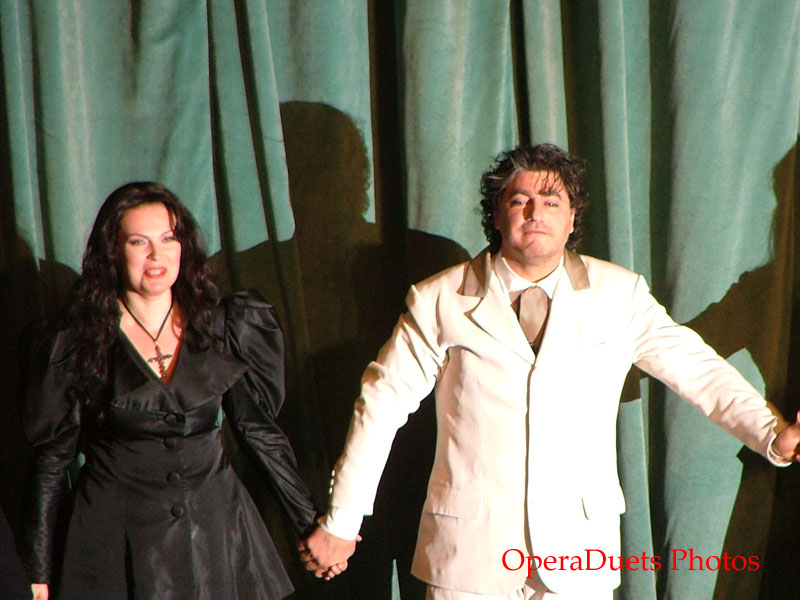
October 30, 2010: Samson et Dalila in Karlsruhe

2010-10-30 Samson et Dalila (C. Saint-Saëns),Badisches Staatstheater Karlsruhe

Samson = José Cura
Dalila = Julia Gertseva
Abimelech = Lukas Schmid
High Priest = Walter Donati
Ancient Hebrew = Walter Shreyek (statist) / Luiz Molz (voice)
First Philistine = Sebastian Haake
Second Philistine = Alexander de Paula
Messenger = Andreas Heideker
Young Hebrew = Sebastian Shaible

Jochem Hochstenbach, conductor

Inszenierung - José Cura
Ausstattung - José Cura
Einstudierung der Chöre - Ulrich Wagner
Dramaturgie - Annabelle Köhler
Regieassistenz - Eva Schuch
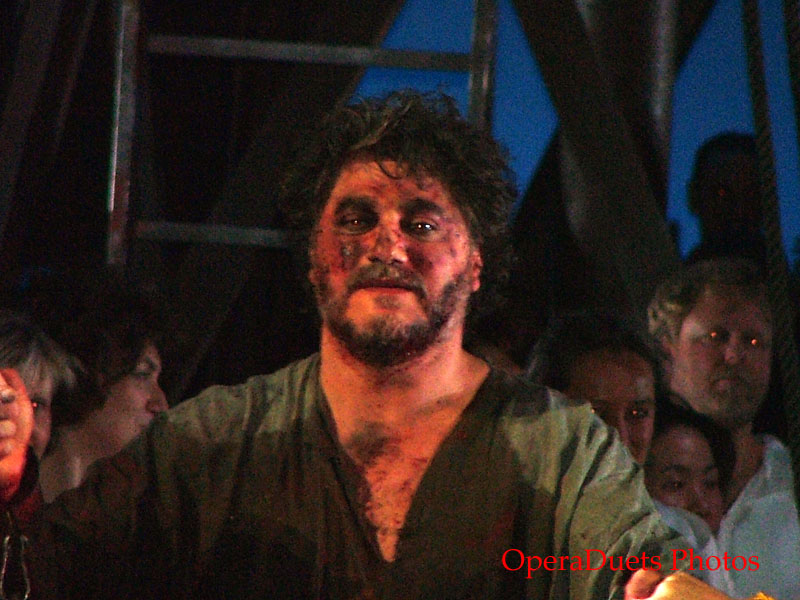


I would love to say that I really loved this production of Samson et Dalila since this was with REGIE UND AUSTATTUNG José Cura. What is great about this production is that the concept works, it makes sense and it does not go against the music or the words in the opera. I think that Regie and Konzept is often made against the story and music and very often just to shock, that is the cheap way to work. Here you have the opposite someone really doing the REGIE as the handiwork it should be. And so here it works. Without earlier knowledge of the opera and story the production works even better. Then there are some errors that directors should try to avoid. One should never have to read the concept of director in order to understand it and it should be obvious who is who. It was not obvious that the children dressed in red was Philistine children. Had the Philistine been dressed in red and not in a formal dark wear (Abimelech, Grand Prêtre) it would have been clear that children in red are Philistine, other children are Hebrew. With some of the important ideas of José Cura is the children, the innocent ones, trying save each other, not caring who is the enemy. Without clarity here much understanding is already lost in act 1.

My other complaints are much more my personal view. In my view it was too much violence showing here. Compared to other "shows" it is not too much violence. But it is José Curas choice to show how violent the regime the Hebrew are under. This does undermine the other idea that José Cura has that Samson is nothing more than a suicide bomber using religion as a pretext for violence. With violence so great must not revolt come and therefore is not Samson forced to become the leader. That is just my view. So Samson is a hero in this production even if Cura is trying to show us that this revolt was not without Hebrew casualties.

In this concept the Old Hebrew is killed by the High Priest in front of the children and women. The children dressed in red then saves more lives from the murderous High Priest. But if you have not read in the program that this means Philistines are saving Hebrews, children saves children, then one important point is lost. Because the Old Hebrew is killed before the "Hymne de joie, hymne de délivrance" sung by the Old Hebrews and other elders this become a sombre song offstage as we see the dead Hebrews are carried into the stage. Still it does not really make sense that the High Priest should shoot the Old Hebrew as he sings "Maudit soit le sein de la femme qui lui donna le jour!". Why shoot a man when he could strangle the woman who might just be Samson's mother or wife? It would have been really chilling. But then the concept would not work, or what...

Here there are no doubt about Dalila. She never loved Samson. This Dalila is a woman that is callous and uses her allures to trap men and to be powerful and rich. I can accept that but I would have loved her to have many layers to her. I find it harder to just accept the sexualization of Dagons priestesses. But then they are just Dalila's tools. It is as if we are to believe that Dalila and her "sisters" hate men because they love women. I find it cheap. And I find it strange that all the priestesses are inside Dalila's hut the Soreck valley.

When the High Priest visits Dalila he is shown as big shadow behind the tall veil. Unfortunately this High Priest as he is singing hiw big shadow makes any tremulus in the hands very visual and that goes against his portrayal as a strong man.

José Cura showed himself as a man capable to create a Samson et Dalila that is really modern and true to the music. The rave reviews was not completely unjustified. And then there is the voice and acting of José Cura. He is the complete Samson. Wonderful singing and acting. Julia Gertseva was Dalila. She is a promising Dalila, her voice is sometimes just short of really opening up and then she could be a Dalila for the ages. Other than that, she is spotless. The other singers was not up to the highest standard where Cura and Gertseva reigned. The chorus was exceptional. The statists did a good job. The children was wonderful.

In the end I will mention the teenager, an invention of José Cura. A long-haired teen-ager that I thought would be like a Samson double. It is an operatic trend of using doubles in opera. But in this production he is just the ardent follower of Samson who idolizes Samson. He is disappointed by Samson when he falls for Dalila, but when he himself is used by Dalila, he understands and forgives and saves the children from the destruction of Samson on Samson's command.

Tuesday, October 10, 2017

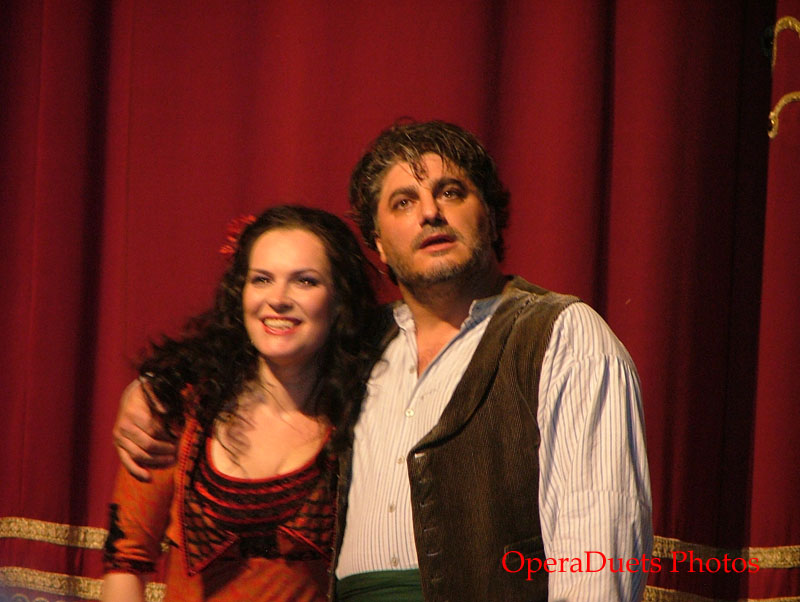
October 10, 2009: Carmen in Munich

2009-10-10 Carmen (G. Bizet),
Bayerische Staatsoper (Munich)

Carmen = Julia Gertseva
Don José = José Cura
Escamillo = Teddy Tahu Rhodes
Micaëla = Maija Kovalevska
Zuniga = Christian Van Horn
Moralès = Nikolay Borchev
Dancairo = Christian Rieger
Remendado = Kevin Conners
Frasquita = Lana Kos
Mercédès = Heike Grötzinger
Lillas Pastia = Manfred Ultsch

Karel Mark Chichon, conductor


CARMEN: This time, like all other times with Carmen, the conductor is too fast in the Prelude. I think the rest of the world disagree with me, but that is my opinion. What can I say about the production? Well, it was YELLOW. Is that a code for Seville... It was in my opinion a fairly traditional Carmen. There was some really good ideas there and sometimes the execution of ideas was wonderful. Julia Gertseva was a wonderful Carmen. I had not expected to love her as Carmen, but Carmen is really her role. Brilliant. José Cura was an excellent Don José. Vocally and acting brilliantly. The only thing is that here is French dialog. And that is hard stuff. I really think Julia Gertseva was the best in dialog, very clear, easy to hear, unfortunately I doubt it was the best French diction. Micaela was sung and acted superbly by Maija Kovalevska. It must have been the best Micaela I have seen. Zuniga and Morales seemed to young. Nikolay Borchev (Morales) seem to be the old type opera singer who sings to the audience. Christian Van Horn (Zuniga) right voice but too young for Zuniga. The smugglers Dancairo (Christian Rieger), Remendado (Kevin Conners) was alright, but Frasquita and Mercedes was another species of singers. Lana Kos was nothing short of wonderful as Frasquita. She makes you want more. Beautiful woman, voice and a sure actress. Heike Grötzinger as Mercedes was also a luxury Besetzung. This time one felt that Frasquita could easily become Micaela, and Mercedes could be Carmen.

Act 2 a gipsy camp with tents. I don't like it. And then the Fat Lady as Fat Gypsy Lady. OK, no not OK. A little too much of EXOTISM made of Gypsies, especially Gypsy Women, Zigeunerinnen. Problematic, the ROM people has been marginalized a long time when not looked as Exotic. OK, so it is CARMEN. But a little more respect. A big program but nothing about how the Roma people was treated in Spain in the time of Carmen or about how it is now or why not in the European History. But essays, essays about other things. Our chance of insight wasted. Insight of women's situation in Spain would be appreciated instead of just Carmen and who was she, what kind of love... boring stuff.

I almost forgot Teddy Tahu Rhodes as Escamillo. Doesn't that say it all. Almost forgot. Yes, young and beautiful (handsome, I mean), but it the end easy to forget. The last duet with Carmen (Julia Gertseva) and Don José (José Cura) was absolutely the best. Ever...

OD Travel + Photos
My Original blog post

For more reviews from my travels, see www.operaduetstravel.com
If you want to see more photos from my OperaDuets Travels, go to www.operaduetsphotos.com

Tuesday, July 4, 2017

July 4, 2008: Edgar in Turin, Italy

2008-07-04 Edgar (Puccini), Teatro Regio di Torino

Edgar = José Cura
Fidelia = Amarilli Nizza
Tigrana = Julia Gertseva
Frank = Marco Vratogna
Gualtiero = Carlo Cigna

Yoram David, conductor


Edgar

Teatro Regio, 25 Giugno 2008 - 6 Luglio 2008

Dramma lirico in quattro atti
Libretto di Ferdinando Fontana
dal poema drammatico La Coupe et les lèvres di Alfred de Musset

Musica di Giacomo Puccini

Prima esecuzione della versione originale in quattro atti
nella ricostituzione effettuata sull’autografo a cura di Linda B. Fairtile
con la collaborazione di Gabriele Dotto e Claudio Toscani - Edizioni Casa Ricordi


Direttore d’orchestra / Yoram David
Regia / Lorenzo Mariani
Scene e costumi / Maurizio Balò
Luci / Christian Pinaud
Assistente alla regia / Elisabetta Marini
Assistente ai costum / Alessandra Gramaglia

Maestri del coro e del coro di voci bianche /
Claudio Marino Moretti
Claudio Fenoglio

Orchestra e Coro del Teatro Regio
Coro di voci bianche del Teatro Regio e del Conservatorio "G.Verdi"

Nuovo allestimento
in co-produzione con il Teatro Comunale di Bologna

The opera EDGAR by Giacomo Puccini was a much longer opera then I had thought. It was the 4 act version and according to the opera house it was with 2 intervals both 25 minutes and the opera was to end at 2330. It lasted to ca. 2345.

The only piece I knew from the opera was the tenor's aria from act 2 "orgia, chimera". It was a beautiful aria. The opera itself did not have many memorable musical moment except this aria. But here and there was Tosca, Madama Butterfly, Boheme melodies in it more raw form that was to be perfected in his later operas. The story of EDGAR was also flawed. No person became real person. Fidelia (the soprano) was simply just a good person, very true to Edgar. Tigrana (the mezzo soprano) had similarly just one level, she was simply only a seducer of men, provocative to others, egocentric. Frank, Fidelia's brother, was a good man inexplicable in love with Tigrana in the beginning and still a good man in the end. Gualtiero, their father, also good from beginning to end. And EDGAR himself, in love with two women, Fidelia for the purity and Tigrana for he seductive powers.

Act 1: Fidelia declare her love to Edgar. Tigrana mocks Edgar for being interested in pure love. She wants him back. Frank wants to know where Tigrana was, he waited for her. She doesn't want anything to do with him. Tigrana is acting provocative to the people of the village. In the end they want to drive her out of the village. Then Edgar comes in for the rescue. He is so angry with the village that he burns his own house and go away with Tigrana.

Act 2: Tigrana and Edgar has a castle with orgies going on all the time and gambling. Edgar is bored and wants out (Aria: Orgia, chimera). Tigrana will never let go of Edgar unless she herself is bored with him. Frank is a soldier now and his company visits Edgar's castle and now Edgar has found a way out as a patriotic soldier.

Act 3: Edgar's funeral except that Edgar is not dead, he pretends to be a monk. Frank tries to have a solemn funeral for the patriotic soldier Edgar. But the monk is making the crowd angry with his stories of Edgar's former life. The burning of the paternal home and running away with Tigrana, the courtesan. And his gambling and the orgies. The crowd is angry but Fidelia is telling the crowd that Edgar was not all that bad. And the crowd is no longer angry. But then Tigrana arrives pretending to be mourning Edgar. Edgar and Frank decides to out her as a liar. They used flattery and jewels and money. And then she agrees to tell the crowd that Edgar was thinking about deserting his country. Now the crowd is unstoppable and they open the casket but it is empty. Edgar reveals himself. And Tigrana is now proved a liar. And the village people is shocked by their own behavior as Edgar really was a war hero.

Act 4: Fidelia still thinks Edgar is dead. In a dream he has told her that she can be his wife in heaven. But the Edgar comes in and declares that first she will be his wife in the world. Beautiful love duet. Then Tigrana comes in and stabs Fidelia. Fidelia is dying while the village people prepare the wedding. Then Edgar comes back, he sees the blood. Fidelia can show her killer before she dies. And the END.

The production was beautiful and scenography was very natural, almost old-fashioned. The opera house was not full with people so the acoustics was not always the best. Amarilli Nizza was not the best voice, Julia Gertseva was better. Marco Vratogna and Carlo Cigni was really good as Frank and Gualtiero. And it was another triumph for José Cura as Edgar.

OD Travel + Photos

Original blog posts:
I saw Jose Cura in Turin July 5, 2008
Puccini's second opera in Turin (July 4th, 2007)

For more reviews from my travels, see www.operaduetstravel.com
If you want to see more photos from my OperaDuets Travels, go to www.operaduetsphotos.com