Pages

Showing posts with label Ekaterina Gubanova. Show all posts

Thursday, December 14, 2017

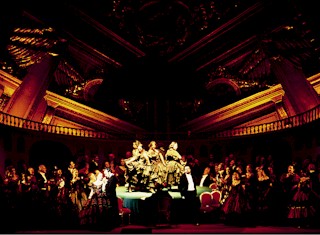
December 14, 2002: La Traviata in London

2002-12-14 La Traviata (G. Verdi), Royal Opera House (London)

Violetta Valéry = Inva Mula
Flora Bervoix = Ekaterina Gubanova
Marquis d'Obigny = Graeme Danby
Baron Douphol = Darren Jeffery
Doctor Grenvil = Graeme Broadbent
Gastone de Letorières = Elliot Goldie
Alfredo Germont = Edgaras Montvidas
Annina = Gillian Knight
Giuseppe = Neil Gillespie
Giorgio Germont = Paolo Gavanelli
Messenger = Thomas Barnard
Servant = Jonathan Coad

Paolo Carignani, conductor

Worth hearing for Gavanelli, Carignani and Montvidas
17 Dec 2002 Guardian Unlimited
Youth is wasted on the old
16 Dec 2002 The Times

The Times critized the production, which I truly liked.
Edgaras Montevidas was cited as "one of the best things about the evening" I also found him good, maybe even better in the role than The Times Reviewer Robert Thicknesse, but the criticism on Inva Mula, the Violetta of the evening, who I found nothing less than perfect as singer and actress. He also say that the chorus did not follow the beat of the conductor, I did not hear that, nor that the chorus turned "the two parties into funerals". Truly the parties was like parties, high spirit. (The Times gave 3 stars out of 5)

The Guardian and I agreed on the tenor Edgaras Montvidas:
"His voice, reedy and elegant, is on the small side, though he sings with an instinctive feel for the inner pulse of Verdi's music. He is a convincing actor, too, first approaching Violetta with a combination of gauche desire and the stiff-backed wariness of someone tentatively breaking away from the legacy of a morally rigid upbringing. When he publicly denounces her, he is ambivalent and wretched rather than blind with rage. "
But on Inva Mula, the Albanian soprano I disagree.
"In fact, he is better than Violetta, the Albanian soprano Inva Mula. She can sing and act, though not always at the same time: she delivers the bulk of her vocal utterances straight to the audience, then follows them up with the requisite dramatic gesture aimed at whichever character she is with on stage. She abandons this habit when she gets to the final scenes, by which time one's sympathy is wearing thin. Her voice has a dramatic tang, though she is over-fond of hanging on to high notes, slowing the score whenever she does so. "

About Paolo Gavanelli as Giorgio Germont, I will just say that he is more mellow in tone than Renato Bruson, but this Germont père was not symphatic enough, not even in the last act. His remorse seemed superficial.

BRAVA, Inva Mula!!!

(would have been an absolutely perfect evening, if the people had not coughed so much, I think it must have been 10 or 12 people coughing) Violetta almost didn't have a change against that.

THE ROYAL OPERA
COVENT GARDEN
Music Director Antonio Pappano
Director of Opera Elaine Padmore
presents
LA TRAVIATA
Opera in three acts
Music Giuseppe Verdi
Libretto Francesco Maria Piave
after Alexandre Dumas fils's play La Dame aux camélias
Conductor Paolo Carignani
Original Production Richard Eyre Directed by Daniel Dooner Designs Bob Crowley Director 0f Movement J ane Gibson Lighting Jean KaIman
The Royal Opera Chorus Chorus Director Terry Edwards
The Orchestra of the Royal Opera House Concert Master Peter Manning
Saturday 14 December 2002 The 384th performance at the Royal Opera Hause
Sponsored (1994) by The Jean Sainsbury Royal Opera House Fund
LA TRAVIATA
Ladies and gentlemen, friends 0/ Violetta and Flora,
guests, servants

OD Travel

For more reviews from my travels, see www.operaduetstravel.com
If you want to see more photos from my OperaDuets Travels, go to www.operaduetsphotos.com

Sunday, November 19, 2017

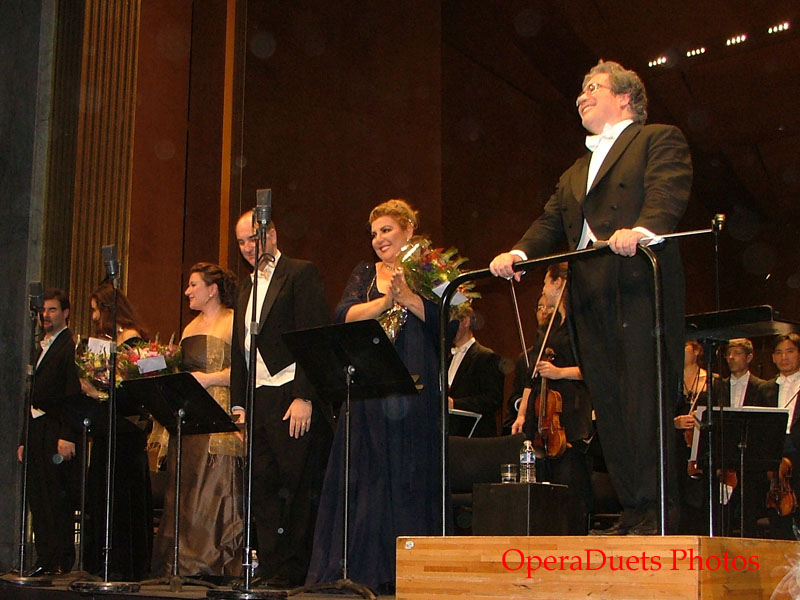
November 19, 2011: Oberto in Paris, France


2011-11-19 Oberto (Verdi), Theatre des Champs-Elysees (Paris)

Riccardo = Valter Borin
Cuniza = Ekaterina Gubanova
Leonora = Maria Guleghina
Oberto = Michele Pertusi
Imelda = Sophie Podjiclis

Carlo Rizzi, conductor

Orchestre National de France
Chœur de Radio France
direction Kalman Strausz


Oberto by Verdi in Theatre des Champs-Elysee. Concert version. From the first notes of the ouverture it was definitely Verdi. The first opera by Giuseppe Verdi, so of course it was young Verdi that some times sounded a bit like the older opera composers. Valter Borin sang Riccardo as Fabio Sartori was unwell. He sang Riccardo's two arias beautifully. In Oberto the tenor (Riccardo) is the villain and the bass (Oberto) is the hero.

Maria Guleghina with blond hair and glasses, she looked wonderful. Unfortately she was not well so sometimes the planned execution of notes did succed, but she was still able to make this Leonora a special treat. For those that simply does not like Maria Guleghina even tried to pin the the cutting of caballettas to the soprano, but it was more Radio France etc.

Ekaterina Gubanova sang the role of Princess Cuniza. The mezzo-soprano was in great shape and showed the noble Cuniza in all her glory.

Michele Pertusi was Oberto, father of Leonora and the enemy of Riccardo. Oberto is obsessed with honour. For modern eyes Oberto is too into himself and his own feelings to think what actions would mean for his daughter. Riccardo on the other hand only realize how wrong he has acted after he kills Oberto. Michele Pertusi was wonderful as Oberto, naturally.


OD Travel + Photos
Original blog post

For more reviews from my travels, see www.operaduetstravel.com If you want to see more photos from my OperaDuets Travels, go to www.operaduetsphotos.com
Tuesday, July 4, 2017

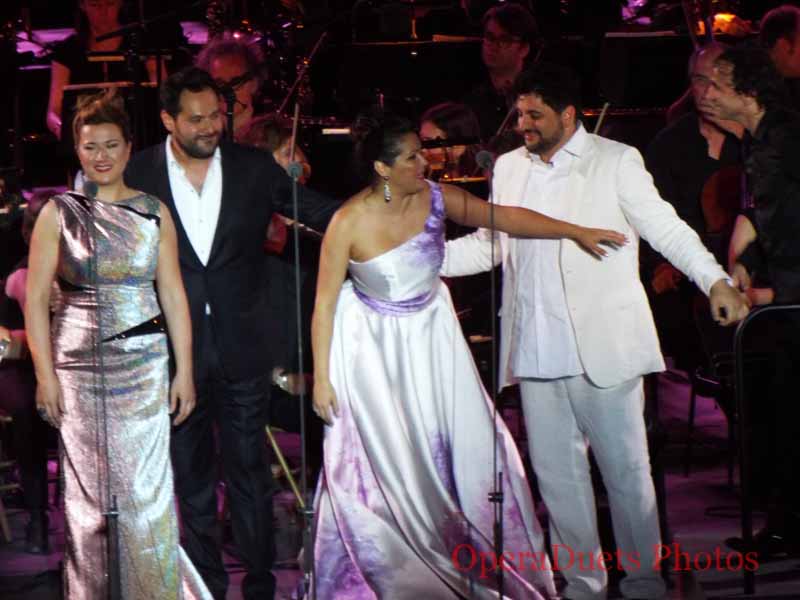
July 4, 2015: Gala Anna Netrebko & Friends in Versailles

2015-07-04 Gala Anna Netrebko & Friends, Versailles

Anna Netrebko, soprano
Ekaterina Gubanova, mezzo
Yusif Eyvaziv, tenor
Ildar Abdrazakov, bass

Orchestre National d’Île-de-France

Marco Armiliato, conductor


♦ PROGRAMME
Giuseppe Verdi • I vespri siciliani
Sinfonia – Orchestre
Giuseppe Verdi • Aida
“Se quel guerrier io fossi… Celeste Aida” – Y. Eyvazov
Giuseppe Verdi • Aida
“Qui Radamès verrà… O patria mia” – A. Netrebko
Giuseppe Verdi • Ernani
“Infelice!… e tuo credevi… Infin che un brando vindice” – I. Abdrazakov
Francesco Cilea • Adriana Lecouvreur
“Acerba voluttà” – E. Gubanova
Giuseppe Verdi • Otello
“Gia nella notte densa” – A. Netrebko, Y. Eyvazov
Giuseppe Verdi • La Force du destin
Sinfonia – Orchestre
Giuseppe Verdi • Don Carlo
“Nel giardin del bello saracin ostello”– E. Gubanov
Ruggero Leoncavallo • Pagliacci
“Recitar ! Vesti la giubba” – Y. Eyvazov
Arrigo Boito • Mefistofele
“L’altra notte in fondo al mare” – A. Netrebko
Giacomo Puccini • Manon Lescaut
Intermezzo – Orchestre
Giuseppe Verdi • Attila
“Mentre gonfiarsi l’anima parea dinanzi a Roma… Oltre quel l’imite t’attendo” - I. Abdrazakov
Giuseppe Verdi • Don Carlo
“O don fatale” – E. Gubanova
Gioachino Rossini • Le Barbier de Séville
“La calunnia è un venticello” – I. Abdrazakov
Ernesto De Curtis • “Non ti scordar di me” (arrangement Julian Reynolds)
A. Netrebko, E. Gubanova, Y. Eyvazov, I. Abdrazakov

Yusif Eyvazov is a wonderful tenor! A new name for, Yusif Eyvazov, to adore.

Ildar Abdrazakov. What a great voice he has!! It was like abrakadabra great! He is just the most amazing bass. I love his impossible low, strong voice. From the old da Silva in Ernani to Attila, La Calunnia and extra number Mephisto from Faust. BRAVO!!

I had no time to read the programme so I was amazed when The Tenor was so amazing in Celeste Aida and in the love duet from Otello with Netrebko. I bought my program in the interval but still did not read it. So still believing him to be A. Antonenko I loved his Vesti la giubba, then Nessun dorm as extra number. But now I known name of the Unknown Prince, it is Yusif Eyvazov!!! My new tenor love! BRAVO, Yusif!!! I wish you to have a great opera career!! Adore him all!

Ekaterina Gubanova as the Princess of Bouillon in Adriana Lecouvreur is my next wish to see her. I loved Luciana D'Intino as she sang this role in Opera Bastille the day before as so that was the reason I recognized the first aria Gubanova sang and I just loved it. She was just everything you can dream of in this aria. I love Don Carlos and wants to see Gubanova as Eboli, so I loved her singing the two arias from Don Carlo in part 2.

Anna Netrebko sang O Patria mia from Aida, the love duet from Otello with the tenor, but she did not sing the aria from Mefistofele, she sang Un bel di vedremo from Madama Butterfly. As extra number she sang Barcarolle from Hoffmann with Gubanova, and she sang an operetta aria.


They all sang NON TI SCORDAR DI ME both in program and as last extra. And we will not forget!!

OD Travel & Photos
Original blog post

For more reviews from my travels, see www.operaduetstravel.com If you want to see more photos from my OperaDuets Travels, go to www.operaduetsphotos.com
Wednesday, June 21, 2017

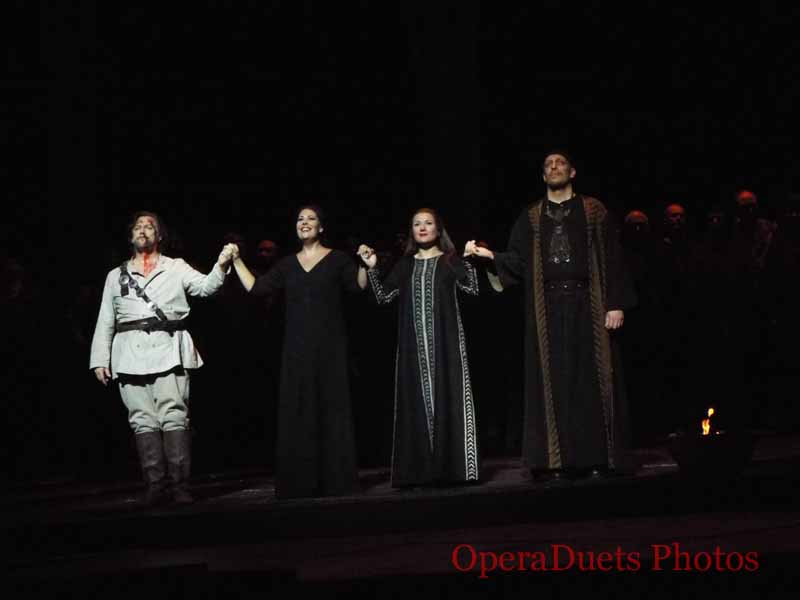
June 21, 2015: Norma in Munich

2015-06-21 Norma (Bellini), Bayerische Staatsoper

Norma = Sondra Radvanovsky
Adalgisa = Ekaterina Gubanova
Clotilde = Golda Schultz
Pollione = Gregory Kunde
Flavio = Francesco Petrozzi
Oroveso = Mika Kares

Paolo Carignani, conductor

Inszenierung, Bühne und Kostüme, Lichtkonzept - Jürgen Rose
Choreographische Mitarbeit - Jo Siska 
Licht - Michael Bauer
Produktionsdramaturgie - Peter Heilker 

Chöre - Stellario Fagone


Finally, Norma! Live from Munich with Sondra Radvanovsky and Ekaterina Gubanova as Norma and Adalgisa.

First time to see this opera live for me. Sondra Radvanovsky, who I saw last time in London as Lina in Verdi's Stiffelio 8 years ago, has become NORMA in a very big way. She is there alongside with Maria Callas, Joan Sutherland and Montserrat Caballé. Ekaterina Gubanova, who I have loved ever since Oberto in Paris in 2011, was equally amazing as Adalgisa.

Gregory Kunde was Pollione instead an indisposed Massimo Giordano. He was Pollione with gusto but not my cup of tea, so to speak. Mika Kares was a wonderful Oroveso. Frnacesco Petrozzi was Flavio and I wanted more from him like he should be singing Pollione with his beautiful voice.

Golda Schultz did her job in the little and yet important part of Clotilde. Parolo Carignani conducted it all.

Two children played the roles of the children of Norma and Pollione. Poor children!! Innocent young boys with a mother who loves (and hates) them.  A father who in the end is more a lover than a father. I still wonder if Norma was the only to die (did she die?), was Adalgisa also killed, did the children really get a chance to live safely with Oroveso, or ... Did Pollione die (killed by the Druids)?


The music is divine but who can love Norma or Pollione. Adalgisa can, I cannot. But I can love Adalgisa and wish the children did get a chance of love from ever lovable Adalgisa.

OD Travel & Photos
Original blog post

For more reviews from my travels, see www.operaduetstravel.com If you want to see more photos from my OperaDuets Travels, go to www.operaduetsphotos.com